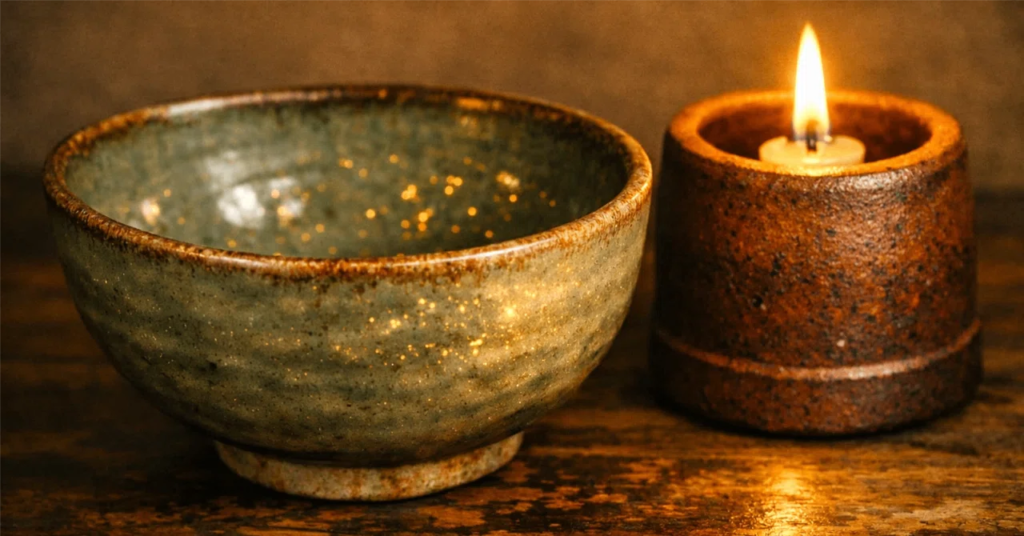
The vessel finished firing
on a spring evening.
The flame in the kiln had already died,
leaving only a quiet red afterglow.
The wood‑ash glaze had melted
into a color somewhere between pale green and soft gray,
with tiny specks shimmering here and there.
Almost no one can make this glaze anymore.
You burn wood,
separate the ash,
sink it in water again and again to remove the bitterness,
dry it, crush it—
only then does it become glaze.
“It takes too long.”
“It’s inefficient.”
That’s what people said,
and so many kilns abandoned the technique.
But she knew
that within that inconvenience
lived the memory of fire and plants.
When she gently lifted the vessel,
it was still warm—
as if the memory of the flame
remained inside the clay.
“From here,” she whispered,
“the second fire begins its work.”
She lit the tabletop hearth.
Inside its amber-colored chamber,
a small flame rose softly.
Its light held a temperature
entirely different from the kiln’s.
When she placed the vessel beside the hearth,
the surface of the glaze began to shift.
Depending on the angle of the light,
the green deepened,
the gray softened.
“This expression…
industrial glazes can’t do this.”
The hearth’s flame illuminated
the tiny grains of ash buried deep within the glaze,
bringing forth the expressions
that had been hiding there.
The kiln’s fire creates the form.
The hearth’s fire reveals the meaning.
Only when the two fires meet
is the vessel truly complete—
and she realized this for the first time.
A faint shimmer ran across the surface,
as if the memory of the burned wood
had taken one last gentle breath.
“Fire remembers
the techniques that are fading away.”
She smiled.
The flame in the hearth swayed quietly,
and the glaze shifted once more.
The second fire
continued to softly illuminate
the memory of a craft on the verge of disappearing.