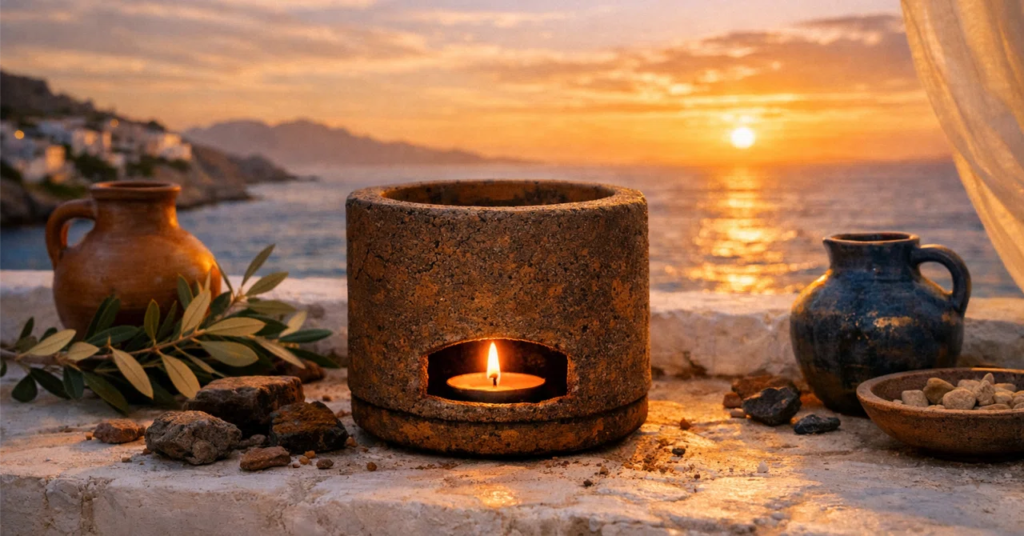
In the Mediterranean,
there is a light that has never changed since ancient times.
In the morning, the sea shimmers silver,
at noon it deepens into blue,
and by evening, a golden wind begins to blow.
The lands that surround this sea
gave birth to civilizations,
welcomed countless travelers,
and let the cultures of fire and earth mingle without end.
Fire was the very heart of the Mediterranean story.
On the Greek islands,
a small hearth stood at the center of every home—
a symbol of the family itself.
In Rome,
the sacred fire of Vesta burned as the guardian of the city,
and its extinguishing was seen as an omen for the state.
In the fishing villages along the coast,
fires were lit on the night shore,
and fishermen mended their nets
while listening quietly to the breathing of the sea.
Mediterranean fire
was not only warmth—
it was a light that bound people together.
Earth was the memory of the Mediterranean.
The soil here is red,
rich with iron,
burned by the sun,
polished by the wind,
and over long ages becomes clay.
From that clay came vessels
that protected olive oil,
carried wine, stored grain,
and sustained the lives of travelers.
Greek black-figure pottery,
Roman amphorae,
North African red clay jars,
Turkish vessels glazed in deep blue.
Their shapes differed,
yet earth remained the shared language
that connected civilizations.
The Mediterranean was a crossroads
where fire and earth traveled freely.
Phoenician ships crossed the sea,
Greek potters passed down their craft,
Roman merchants carried vessels across empires,
and Arab scholars recorded the knowledge of fire.
Fire traveled.
Earth traveled.
Cultures intertwined,
and the Mediterranean became a small mirror of the world.
For every culture around this sea,
fire and earth were life,
prayer, and story.
A small hearth-lantern resonates deeply
with this Mediterranean memory.
People gather around a gentle flame,
share warmth in the quiet,
and let earthen vessels hold that moment in place.
A lantern shaped from Japanese earth
would settle naturally into a Mediterranean home—
a white stone house,
the shade of an olive tree,
a terrace brushed by sea wind.
Placed there,
its flame would carry the same meaning
as the fires ancient families once gathered around.
Fire is the language of humanity.
Earth is its memory.
A lantern is a small cultural instrument
that returns both
to the quiet of the present age.